




From the outside: boom. From the inside: building the foundation. What is really happening at Moruga right now
Recently, an article about Moruga was published in the Berliner Zeitung. Of course, moments like this make us happy. From the outside, the story reads quite clearly: cacao instead of coffee, strong growth, suddenly a lot of attention, a company that has become significantly larger in a short time.
What an article like that naturally cannot show is the other half of the story.
Because from the inside, 2026 does not simply feel like growth. It feels more like a year that will decide how resilient Moruga really is: as a supply chain, as a team, as a company and, honestly, for me personally as a founder.

Over the past few months, we have seen how quickly a brand can become visibly larger, and how much work it takes to move the structures behind it at the same pace. When cacao prices go wild, bureaucratic decisions suddenly have six-figure consequences and more and more people are discovering us at the same time, you very quickly notice what really matters.
Not buzzwords.
Not pretty brand rhetoric.
But substance.
That is exactly what this year is about for us.
And because many new people are currently discovering Moruga, I want to use this post to show more personally and concretely what is really happening behind the scenes: what we are working on, what is difficult right now, what gives us momentum and why this year could become even more important for us than the last one.
Growth is only the visible side
From the outside, growth often looks like validation. And of course it feels good when more people understand what we actually want to build with Moruga: establish a real alternative to coffee and at the same time show that cacao is a much more fascinating food than most people in Europe have been taught.
But growth always creates friction too.
More volume means more planning. More responsibility. More upfront financing. More coordination. And above all: less room for error. Things we could still somehow improvise two years ago suddenly become expensive, slow or risky under growth.
Moruga has grown strongly over the past few years. But this year, for me, it is less about simply continuing to grow. It is about making that growth sustainable and preparing Moruga for the next chapter.
This year feels more fragile than it looks from the outside
I think that is the most honest sentence I can say about Moruga in mid-2026.
From the outside, Moruga looks like a classic startup in its scaling phase. More reach. More orders. More press. More attention.
From the inside, it feels more fragile at the same time.
Not because I believe in Moruga any less. But because the world has become more unsettled. Willingness to buy is understandably more cautious. Markets react more nervously. Raw material prices remain vulnerable. And geopolitical tensions can quickly push developments that are just starting to ease back in the other direction.
When you build a small company that works with a natural product, you do not read about such movements abstractly in the business section of a newspaper at some point. You feel them directly in purchasing, cash flow, delivery times and, in the end, in your own gut feeling.
That does not mean we have become nervous. But it does mean we have to think more carefully, more clearly and more long-term than we did two years ago.
Why the supply chain takes up so much space this year
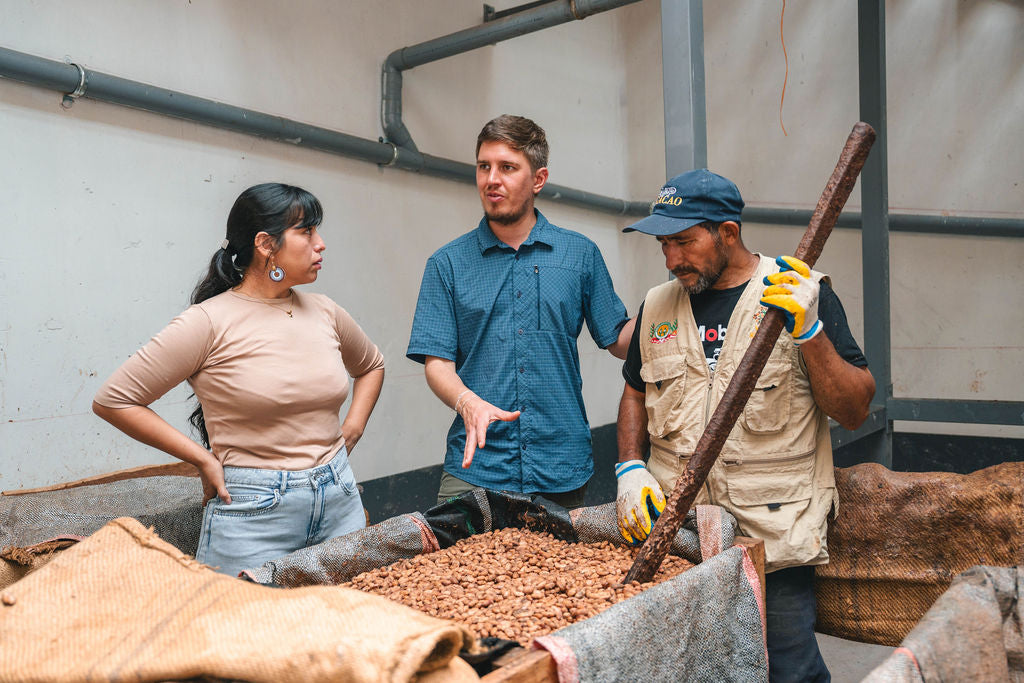
I have just returned from Peru together with Moritz. Trips like this are always important to me. Of course, because they strengthen relationships. But above all because being on site makes you feel very concretely how much is behind a functioning supply chain.
Moritz has long been the person at Moruga who keeps many operational threads together and is now also managing director. That is exactly why it was important to me to take this trip together: not only to speak with partners, but to see certain things together, assess them and understand them better.
One of the most important insights for me is this: good supply chains are usually only felt when times become unsettled. They are built in the quieter phases before that.
And that is why I am especially grateful right now for our long-term collaboration with Original Beans. Without this long-term investment approach, without the deeply rooted cooperation on site and without relationships that go far beyond a normal trading relationship, much of what we do today would not be possible at all. For the beans, we work exclusively with Original Beans; production continues to take place in Switzerland at Max Felchlin AG.

Moritz and I in Peru with part of the Original Beans team
From the outside, "supply chain" often sounds dry. From the inside, it is sometimes surprisingly chaotic, but also deeply personal.
Suddenly, a container from Tanzania is stuck somewhere off Africa three months late. Another is pulled aside in the port of Amsterdam for an organic inspection and sits there for six weeks. Then a bureaucratic nuance is missed somewhere, as recently happened with Arhuaco from Colombia, and suddenly twelve tons of cacao are formally not certified organic, even though they were of course grown organically. Not because anything was done badly at origin. But because one document was signed too late.
That is what I mean when I say: you only truly understand good supply chains when something falls out of rhythm.
That is why we are investing so much energy right now into forecasting, production planning, better visibility on inventory and earlier decisions on volumes and origins. At first, that does not sound especially exciting. But in the end, it is exactly the difference between "we hope it works" and "we can keep growing with a clear conscience."
What is coming into the cup this year
New cacao varieties are, of course, product launches for us. We look forward to them, often work toward them for months, and in the end they arrive in the shop. And honestly: receiving the first fresh samples directly by express mail from the factory is probably still the best part of my job.
But they are never only that.
Every new origin brings new relationships, new quality questions, new planning logic, new risks and new possibilities. That is exactly why we do not launch new varieties simply because launches look good. They have to make sense in terms of flavor, operations and the long term.
This year, Manabí from Ecuador plays an especially important role for us. Not as a decorative range extension, but as part of a more robust setup for the years ahead.
We actually wanted to work with Ecuador earlier. In practice, however, we repeatedly ran into problems that had nothing to do with cacao itself. In recent years, Ecuador has become significantly more unstable, partly because rising cocaine consumption in Europe has shifted important trade routes for the white powder. Pressure on key export ports has increased massively, and different groups fight every day for control and access. For our partners on the ground, in addition to the mental strain, this means uncertainty for logistics, delayed containers and lost planning reliability. It is quite surreal to see how a global issue like illegal drug trafficking can suddenly have a direct impact on a small cacao company like Moruga.
At the same time, we are working on a very small micro-batch from Mexico. I do not want to reveal more just yet. Only this much: it comes from the same producer as our Tabasqueño, grows on a small finca and belongs to a very rare variety. These are exactly the projects that show how much depth cacao can really have.
And because we are interested not only in new origins, but also in new flavor possibilities, we are also experimenting with co-fermentation with the same partner from Mexico. Put simply, this means intervening more deliberately in the fermentation process to bring out specific aroma profiles instead of simply waiting to see what develops on its own. It is not ready to announce yet. But topics like this drive us because they show how much is still possible in cacao when you take it seriously.
Why price pressure is not over yet
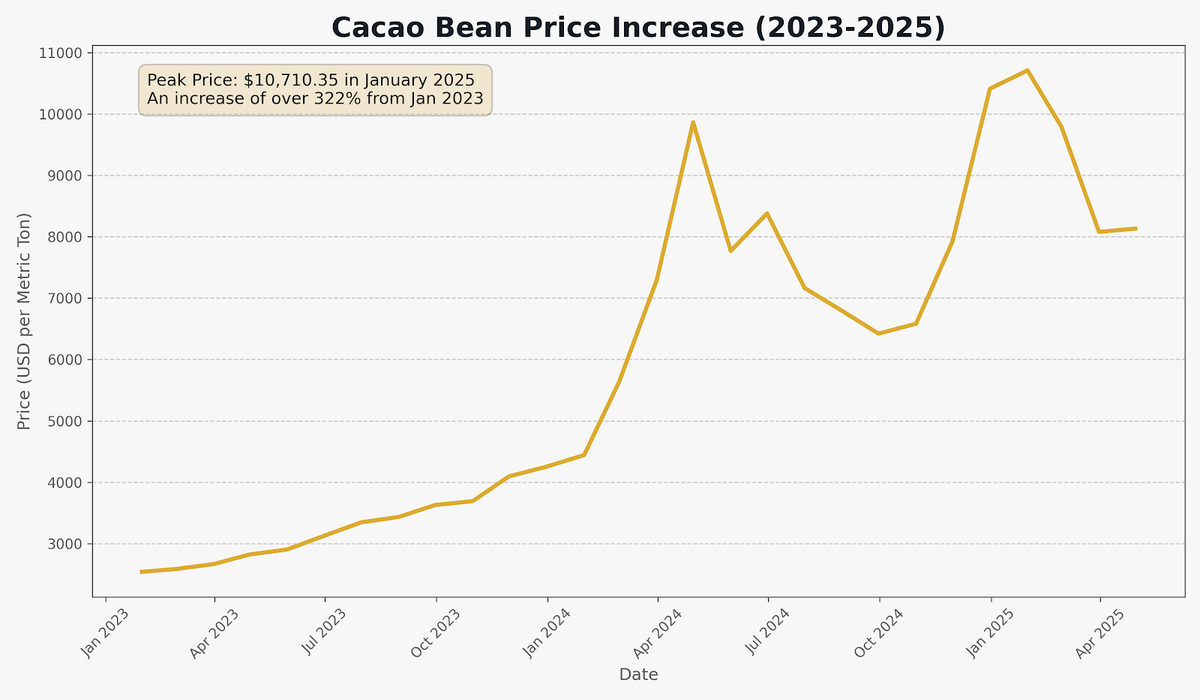
The world market price of cacao was never an abstract discussion at Moruga; it has always been very concrete in our planning. Cacao is not just a small ingredient in a heavily processed product for us. It is the product itself. That is why price movements hit us directly.
The good news is: from the third quarter of this year, we were able to agree on a small price reduction on the purchasing side. That helps. And of course, we hope that some things continue to calm down.
But in my view, it is too early to give the all-clear.
The Iran crisis this spring showed very clearly how quickly prices for transport, energy and fertilizers can come under pressure again. Reuters reported in March and April on sharply rising tanker costs, rerouted or tightening fertilizer supply systems and increasing pressure along global agricultural supply chains as a result of disruptions around the Strait of Hormuz. Even after a possible easing, the backlog of raw materials remains an issue.
Whether and how strongly this will affect cacao again in the coming months remains to be seen. But the direction is clear: if transport costs rise, if fertilizers become more expensive or scarcer and if markets remain geopolitically nervous, it would be naive to believe that food supply chains are unaffected.
My view in mid-2026 is therefore calm, but not carefree: the biggest shock may perhaps be behind us. But this is not normality yet.
The second cost front: German bureaucracy
What is often overlooked publicly: it is not only the world market price that is causing trouble for us, but also the German VAT and customs system.
As already outlined in the Berliner Zeitung article, the customs office took more than a year and a half to classify our product for tax purposes, and in the end concluded that cacao without sugar should be taxed at 19% instead of 7%. The official customs logic is clear: only a mixture of cacao and sugar can be called "chocolate" and receive the reduced tax rate of 7%, or the ominous "cocoa-containing food preparation." According to the customs office, our pure cacao mass, although clearly prepared as a food, belongs to a different customs category and is effectively taxed at 19%.
In practice, it becomes truly absurd. I then get to read 20-page letters from our lawyer arguing with the customs office over the definition of the word "preparation." The customs office says: one ingredient does not make a preparation.
So of course we thought: if cacao mass alone is not a preparation, let us add one ingredient. Wrong.
Customs still classified products with 1% additional organic cacao butter as "cacao mass." The same happened with 1% organic cacao powder. And also with a mixture of 1% powder and 1% butter. At the same time, Lindt EXCELLENCE 100% is currently sold in the German online shop with 7% VAT; its ingredient list includes cacao mass, cacao butter and low-fat cacao powder. The problem for me is not Lindt, and I do not want to attack the brand in any way. The problem is a system that is extremely opaque for companies and economically damaging in its consequences.
For us, this means very concretely: no reliable decision for more than 1.5 years, then a retroactive classification, and with it a potential back payment to the tax office in the six-figure range. We have to repay almost half a million euros. Not because we tried to trick anyone. But because we are operating in a system that is neither fast, clear nor consistent at decisive points. For comparison: our Swiss customs colleagues gave our producers a binding decision within two weeks.
We are therefore currently working with our production partner in Switzerland on the possibility of adding 1% salt. Salt would make sense for us in terms of taste, as a flavor carrier. The German customs office has provisionally classified the product 99% cacao mass + 1% salt as a "cocoa-containing food preparation," meaning 7% instead of 19%. Make of that what you will. For us, and of course for our customers, it matters, because the 12% price difference is noticeable.
Once you have experienced processes like this up close, you look at the word "bureaucracy" differently. It is no longer an abstract founder topic, but something that ties up capital, eats time and slows companies down, exactly where they should actually be investing in quality, people and long-term stability.
The team behind the next chapter
What makes me especially happy in this phase: Moruga is not only getting bigger. Moruga is also becoming more mature.
Not because we suddenly understand business better. But because we are seeing the fruits of work that has long been very consistent, very structured and often quite unspectacular. Many things that look like growth today are actually the result of years of discipline.
This also includes the fact that today more responsibility rests on more shoulders than a year ago.
Moritz holds together an enormous amount operationally, from forecasts and inventory to all those topics that are rarely glamorous in everyday life, but decide whether a company is truly resilient. The fact that he is now managing director at Moruga does not feel like a symbolic step to me, but like a very natural development.
Alicia now leads our marketing at a level that is very good for Moruga. Clearer. More strategic. At the same time closer to the brand. She helps us not simply become louder, but become better at telling our story cleanly.
And behind Moruga there are also several wonderful freelancers who support us in design, content, performance, production, customer support and other areas. That too is part of the truth behind the growth: Moruga is the result of many people who take their work very seriously.

What you will soon also see from the outside
Not everything we are working on remains behind the scenes.
Alongside all the operational topics, we are also working on a rebrand and a new packaging design. We will be able to share the first results soon.
What matters to me is that such a step does not feel like "new shell, same story." When we work on the brand, it is because Moruga has grown as a company and because what we have built deserves to appear more precise, clearer and stronger on the outside too.
How we think about the next steps
Of course we want to keep growing. Of course we want more people to discover Moruga. But I do not believe in growth at any price.
That is why our focus this year is clearly on strengthening Moruga further in e-commerce, making our supply chain more robust and, at the same time, better understanding which additional channels might make sense in the future.
Retail is not an end in itself for us. We are currently testing cautiously, including in the Baltics with a small chain of 13 organic supermarkets, and the response there is positive. Larger campaigns or a broader rollout in the DACH region, however, are more of a 2027 topic for me than something for now. We want to take that path properly if we take it. Not half-finished.
What is non-negotiable for us right now
There are a few things we will not compromise on, no matter how much pressure there is in the market. We will not start buying reach through arbitrariness, we will not trade quality for volume and we will not sugarcoat developments when they are real.
What we do instead is actually quite simple: we keep building our supply chain, even when it is demanding, and we pay very close attention to making sure that what ends up in the cup is exactly what this was about from the beginning: exceptionally good cacao.
The article in the Berliner Zeitung told part of our story, and I am grateful for that. But the truly more interesting part is happening behind the scenes right now. That is where it will be decided what Moruga will be in the coming years: not only a brand that grew quickly, but a company that has not only momentum, but substance.

Danke Jonas für diesen außerordentlich aufschlussreichen und spannenden Beitrag! Meine Frau und ich lieben Moruga – ich habe ihr zum Geburtstag das Starter Kit geschenkt, danach brach beim Thema Kakao eine neue Zeitrechnung an. Wir haben jetzt alle Sorten durch, und machen ab und an eine Zeremonie, auch mit Freunden. Wir unterstützen Euch weiterhin!
Hohe Qualität und “Reinheit” (0 Prozent Zucker) macht euren Kakao einzigartig und ist im Vergleich zu Kakao mit ebenfalls 0 Prozent Zucker , jedoch “Wachmacher-Beimischung” die bessere und sanfter Lösung, in den Tag zu starten. Dass es mit dem Zoll so viele Nickligkeiten gibt, ist traurig…. Gesundes gehört gleich behandelt, gerade wenn kein Zucker im Spiel ist. Auf neue u d auch die schon etablierten Sorten (Arhuaco/Udzungwa…) freue ich mich…..
Wichtig bleibt mir der Kontakt zu den Biobauern. Die Wertschätzung ihrer Arbeit. Der Erhalt alter Kakao Bäume. Und natürlich die faire Bezahlung. Und für euch als Moruga-Team Respekt für eure Arbeit.
Sehr schön und offen erzählt – vielen Dank fürs Teilen, Jonas!
Ich kann jetzt meinen Kakao mit noch mehr Genuss trinken – bei gutem Gewissen, dass ich das richtige Produkt kaufe und damit dieses tolle Unternehmen unterstütze! <3
Super, dass ihr euren Kunden solche Einblicke gebt! Ich finde es wirklich spannend, was alles dahinter steckt und es gibt mir so ein gutes Gefühl. Ich finde es toll, mit welchem Intentionen ihr euer Unternehmen führt. Es ist ehrlich und man spürt, dass Qualität über alles geht. Ich liebe euren Kakao!! :D
Leave a comment